
Benjamin Ferguson
Professor of Philosophy · University of Warwick
I am a Professor of Philosophy at the University of Warwick. I also serve as the Philosophy department's Director for International. Previously, I was a visiting faculty fellow at Tulane University’s Murphy Institute, and held positions in Philosophy at VU Amsterdam and the University of Bayreuth.
My work focuses on moral and political philosophy, especially theories of exploitation, fairness, and the ethics of markets. I have also recently begun research in African bioethics. My papers have been published in journals such as Philosophy and Phenomenological Research, The American Journal of Political Science, Journal of Medical Ethics, and Analysis. My research has been funded by the Dutch Research Council and the British Academy. You can find a list of my current projects and publications on my research page.
I have three current research projects. The first develops a comprehensive theory of exploitation. It examines what it is, why it is wrong, and how it should be addressed. I combine philosophical analysis with empirical research to explore how people apply the concept of exploitation across contexts such as labour, housing, and healthcare.
The second project examines the relationship between supererogation, moral reasons, and permissibility. It investigates how we can make sense of actions that are morally better than required yet still optional, and what this reveals about the structure of moral reasoning.
I also have a growing interest in African bioethics, two topics in particular: the role of consent in communitarianism and the intersection of public health and labour exploitation in an African context.
Journal Articles
We experimentally elicit views of what exploitation is from over 2,000 subjects. Our experimental design does not test existing theories of exploitation. Rather, it focuses on more fundamental properties that are the building blocks for these theories. We find, first, that exploitation is not a vacuous concept: Not all economic interactions are deemed exploitative. Second, contrary to several of the major approaches in the literature, both inequalities in the distribution of economic gains and asymmetric power relations contribute to exploitative relations. What matters most is the interaction of power and inequality: The effect of both elements together is significantly greater than the sum of each on their own. Finally, and perhaps remarkably, we found no major differences in exploitation ascriptions between experts and lay subjects. These findings have implications for the ethics of employment contracts, particularly in the context of sweatshop labor.
Introduction. While there is a global consensus that Lay Community Health Workers (CHWs) should be formally remunerated for their time and effort, they remain unsalaried in most Sub-Saharan African countries, including Zambia. Does this constitute exploitation? To answer this question, we conducted a qualitative study in Lusaka province of Zambia where we interviewed Lay CHWs attached to government healthcare facilities. We juxtaposed the Sub-Saharan African Communitarian (Ubuntu) ethical system and Western ethics to discuss the findings.
Study Methods. We conducted qualitative interviews with thirty-five Lay Community Health Workers in three districts of Lusaka province in Zambia. We adapted the Braun and Clarke (2006) six-step framework of thematic analysis and NVivo computer software to analyse data.
Study Findings. Lay CHWs were motivated by both the intrinsic Ubuntu altruism and economic benefits as they provided community health services in their respective localities. Although they complained about low and inconsistent stipends, as well as a lack of equipment, that did not stop them from serving their communities because of their intrinsic Ubuntu motivation to care for others.
Conclusion. Our study found no evidence that paying Lay CHWs undermined their intrinsic Ubuntu motivation to aid other people, as they continued to serve their communities whether they received stipends or not. It is also our considered view that Lay CHWs are exploited due to their vulnerable positionality, and to avoid that, they should be formally remunerated in line with the WHO recommendation.
International bioethical principles place considerable weight on individual rights and autonomy. They require informed consent for both treatment and diagnostic testing. Although individual rights are widely valued, in some non-Western contexts, they receive relatively less weight than other moral values. In particular, the communitarian African philosophy of Ubuntu places a greater emphasis on the collective good of the community than it does on individual rights. In this paper, we explore differences between an Ubuntu-based bioethics and international bioethical principles through the lens of Zambia’s Universal Routine HIV Testing Services Policy. We find that both the written form of the testing policy and its practical implementation violate standard international bioethical principles of informed consent. However, we show that the policy and its implementation are compatible with an Ubuntu-based bioethics. We conclude with a suggestion that Ubuntu-based bioethics also better capture actual clinical practice in Western contexts than standard bioethical principles based on autonomy and individual rights.
@article{mwinsa2026international,
  author = {Mwinsa, Golden L. and Kasoka, Kasoka and Griffiths, Frances and Ferguson, Benjamin},
  title = {International Bioethics, Ubuntu and HIV Testing in Sub-Saharan Africa},
  journal = {Journal of Medical Ethics},
  volume = {52},
  number = {9},
  pages = {643--650},
  year = {2026},
  doi = {10.1136/jme-2024-110043}
}
This article examines how data-driven humanitarianism in the HIV/AIDS sector reproduces colonial patterns of extraction and inequality in sub-Saharan Africa (SSA). Drawing on case studies of AI-enabled health data systems, it analyses the ethical implications of large-scale data collection, storage, and transfer in contexts marked by poverty, weak regulatory capacity, and persistent stigma. While datafication and artificial intelligence promise efficiency and accountability in HIV response, they also risk coercive consent, exploitation, and surveillance. The article argues that these practices constitute a form of data colonialism, in which the informational resources of SSA are extracted for the benefit of actors in the Global North. It proposes that equitable data governance in health humanitarianism requires transparent agreements, enforceable benefit-sharing, and community accountability rooted in Ubuntu-based bioethics. The goal is not less data, but fairer data - secure, participatory, and oriented toward justice and sustainable health outcomes.
@article{mwinsa2026data,
  author = {Mwinsa, Golden L. and Griffiths, Frances and Ferguson, Benjamin},
  title = {Data-Driven HIV Humanitarianism, Data Colonialism, and Data Ethics: A Sub-Saharan African Perspective},
  journal = {Law, Technology and Humans},
  volume = {8},
  number = {2},
  pages = {139--157},
  year = {2026},
  doi = {10.5204/lthj.3989}
}
In Exploitation as Domination: What Makes Capitalism Unjust, Nicholas Vrousalis rejects fairness-based accounts of exploitation, arguing that exploitation is domination-induced unequal labour extraction. Domination occurs when one violates a ‘Non-Servitude Proviso’ against unilateral control over another’s labour capacity within mandatory cooperation under a division of labour. While we agree that pairing domination with unequal exchange offers the most promising formulation of Marxian exploitation, we raise two challenges to Vrousalis’s general theory. First, his motivating ‘PIT’ rescue case is underdetermined: coercion, non-voluntariness, and unfairness remain plausible explanations of its wrongness. Second, as a general theory, the Proviso yields false negatives when non-labour goods are extracted, generates false positives in unobjectionable cases of capital accumulation, and is indeterminate in several of Vrousalis’s own examples. Rather than rejecting the theory wholesale, we propose friendly amendments: restricting its domain to capitalist economic relations, dropping the ‘mandatory cooperation’ requirement, and rigorously defining unequal labour exchange.
@article{ferguson2025domination,
  author = {Ferguson, Benjamin and Veneziani, Roberto},
  title = {Exploitation as Domination?},
  journal = {Analysis},
  volume = {85},
  number = {2},
  pages = {545--558},
  year = {2025},
  doi = {10.1093/analys/anae007}
}
We consider the apparent inability of theories of exploitation to capture common intuitions about structural exploitation. For example, it seems that consumers participate in the exploitation of sweatshop workers, but there is no direct transaction between the parties. This poses a problem for transactional accounts of exploitation. Many address this problem by appealing to structural exploitation. Existing structural accounts fall, primarily, into two families: weak structural exploitation and strong structural exploitation. We argue neither appropriately captures intuitions about sweatshops. Weak accounts can capture aggregate inequalities but fail to consider relationships or discrete connections. Strong accounts, on the other hand, are sensitive to relationships between exploiters and exploitees, but too demanding about what it takes to exploit to capture consumers' role in sweatshops. We propose a third option, ‘moderate structural exploitation’, that fits ‘between’ existing approaches. Moderate structural exploitation focuses on relationships between the exploited and their exploiter (unlike weak accounts), without appealing to overly strong conditions for who counts as an exploiter (like strong accounts do). We then show that our moderate structural account can not only accommodate intuitions about sweatshops, but also helps assess the exploitation of teachers in the US public education system.
@article{ferguson2025moderate,
  author = {Ferguson, Benjamin and McKittrick-Sweitzer, Lavender},
  title = {Moderate Structural Exploitation},
  journal = {Journal of Applied Philosophy},
  volume = {42},
  number = {5},
  pages = {1454--1475},
  year = {2025},
  doi = {10.1111/japp.70034}
}
Standard accounts of what makes exploitation wrong ground its wrong in distributive unfairness: when A exploits B he wrongs her by taking a greater share of the benefits from their interaction than he ought. I argue that this standard account does not succeed; distributive unfairness is neither the sole, nor the primary wrong of exploitation. I assume that distributive unfairness is pro tanto wrong. However, I argue that in situations where transactors’ consent to a transaction is morally valid, it is also morally transformative and overrides distributive unfairness’s pro tanto wrong. Thus, wrongful exploitation requires morally invalid consent.
@article{ferguson2025grounding,
  author = {Ferguson, Benjamin},
  title = {Exploitation's Grounding Problem},
  journal = {Economics and Philosophy},
  volume = {41},
  number = {2},
  pages = {357--375},
  year = {2025},
  doi = {10.1017/S0266267124000397}
}
This paper argues that two single‐factor accounts of exploitation are inadequate and instead defends a two‐factor account. Purely distributive accounts of exploitation, which equate exploitation with unfair transaction, make exploitation pervasive and cannot deliver the intuition that exploiters are blameworthy. Recent, non‐distributive alternatives, which make unfairness unnecessary for exploitation, largely avoid these problems, but their arguments for the non‐necessity of unfairness are unconvincing. This paper defends a two factor account according to which A exploits B iff A gains unfairly from B and either A believes that the gains he receives in the transaction wrong B, or A is culpably unaware that the gains he receives in the transaction wrong B. This account avoids the problems of non‐distributive approaches and also delivers the intuition that exploiters are blameworthy.
@article{ferguson2021exploiters,
  author = {Ferguson, Benjamin},
  title = {Are We All Exploiters?},
  journal = {Philosophy and Phenomenological Research},
  volume = {103},
  number = {3},
  pages = {535--546},
  year = {2021},
  doi = {10.1111/phpr.12730}
}
What is wrong with colonialism? The standard—albeit often implicit—answer to this question has been that colonialism was wrong because it violated the territorial rights of indigenous peoples, where territorial rights were grounded on acquisition theories. Recently, the standard view has come under attack: according to critics, acquisition based accounts do not provide solid theoretical grounds to condemn colonial relations. Indeed, historically they were used to justify colonialism. Various alternative accounts of the wrong of colonialism have been developed. According to some, colonialism involved a violation of territorial rights grounded on legitimate state theory. Others reject all explanations of colonialism's wrongfulness based on territorial rights, and argue that colonial practices were wrong because they departed from ideals of economic, social, and political association. In this article, we articulate and defend the standard view against critics: colonialism involved a procedural wrong; this wrong is not the violation of standards of equality and reciprocity, but the violation of territorial rights; and the best foundation for such territorial rights is acquisition based, not legitimacy based. We argue that this issue is not just of historical interest, it has relevant implications for the normative evaluation of contemporary inequalities.
@article{ferguson2021territorial,
  author = {Ferguson, Benjamin and Veneziani, Roberto},
  title = {Territorial Rights and Colonial Wrongs},
  journal = {European Journal of Philosophy},
  volume = {29},
  number = {2},
  pages = {425--446},
  year = {2021},
  doi = {10.1111/ejop.12583}
}
This article critically assesses the moral arguments that speak in favour of three consumer options: buying local food, buying global (non‐local) food, and buying global food while also purchasing carbon offsets to mitigate the environmental impact of food transportation. We argue that because the offsetting option allows one to provide economic benefits to the poorest food workers while also mitigating the environmental impact of food transportation it is morally superior to the alternatives.
@article{ferguson2021local,
  author = {Ferguson, Benjamin and Thompson, Christopher},
  title = {Why Buy Local?},
  journal = {Journal of Applied Philosophy},
  volume = {38},
  number = {1},
  pages = {104--120},
  year = {2021},
  doi = {10.1111/japp.12459}
}
We argue that permissibility-based solutions to the paradox of supererogation encounter a nested dilemma. Such approaches solve the paradox by distinguishing moral and rational permissions. If they do not also include a bridge condition that relates these two permissions, then they violate a very plausible monotonicity condition. If they do include a bridge condition, then permissibility-based solutions either amount to rational satisficing or they collapse back into the classical account of supererogation and fail to resolve the paradox.
@article{ferguson2021dilemma,
  author = {Ferguson, Benjamin and Uzunova, Marina},
  title = {A Dilemma for Permissibility-Based Solutions to the Paradox of Supererogation},
  journal = {Analysis},
  volume = {80},
  number = {4},
  pages = {723--731},
  year = {2021},
  doi = {10.1093/analys/anaa033}
}
It is often assumed that morally permissible acts are morally better than impermissible acts. We call this claim Betterness of Permissibility. Yet, we show that some striking counterexamples show that the claim’s truth cannot be taken for granted. Furthermore, even if Betterness of Permissibility is true, it is unclear why. Apart from appeals to its intuitive plausibility, no arguments in favour of the condition exist. We fill this lacuna by identifying two fundamental conditions that jointly entail betterness of permissibility: ‘reasons monotonicity of permissibility’ and the ‘weak classical view’. We then argue that there are good reasons for accepting both of the fundamental conditions. We note that there exist plausible moral theories that reject one of the fundamental conditions. However, the way in which those theories reject the fundamental conditions does not allow them to endorse the counterexamples that motivate the belief that Betterness of Permissibility might be false.
@article{ferguson2020betterness,
  author = {Ferguson, Benjamin and K{"o}hler, Sebastian},
  title = {Betterness of Permissibility},
  journal = {Philosophical Studies},
  volume = {177},
  number = {9},
  pages = {2451--2469},
  year = {2020},
  doi = {10.1007/s11098-019-01319-8}
}
In Do Markets Corrupt our Morals?, Virgil Storr and Ginny Choi confront the ‘virtue-based critique’ of markets, drawing on empirical evidence to argue that markets promote virtue rather than vice. I argue that their defence provides only an indirect response that departs from standard accounts of virtue in three ways. First, all-things-considered comparisons between market and nonmarket societies depend on how distinct virtues are weighed and aggregated. Second, their empirical proxies, particularly for materialism, overlook perfectionist concerns about the content of the ends individuals pursue within value-agnostic liberal markets. Third, because virtues are dispositions requiring counterfactually robust behaviour, market incentives that make actions contingent on profitability often crowd out genuine virtue. Ultimately, Storr and Choi’s argument is implicitly consequentialist: while they convincingly show that markets generate morally good consequences, answering virtue-based critics requires defending the normative claim, which empirical evidence alone cannot settle, that such consequences outweigh motives and robustness.
@article{ferguson2020virtues,
  author = {Ferguson, Benjamin},
  title = {Virtues, Consequences, and the Market},
  journal = {Erasmus Journal for Philosophy and Economics},
  volume = {13},
  number = {1},
  pages = {19--29},
  year = {2020},
  doi = {10.23941/ejpe.v13i1.467}
}
Philip Pettit has argued that the goods of attachment, virtue, and respect are robust goods in the sense that they require both the actual provision of certain benefits and the modally robust provision of these benefits. He also claims that we value the robustness of these goods because it diminishes our vulnerability to others. I question whether robustness really reduces vulnerability and argue that even if it does, vulnerability reduction is not the reason we value robustness. In place of Pettit’s account, I defend a promotional account of the value of robustness. I argue that we value robustness because it increases the probability we will enjoy a certain kind of benefit.
@article{ferguson2018value,
  author = {Ferguson, Benjamin},
  title = {The Value of Robustness: Promotion or Protection?},
  journal = {Moral Philosophy and Politics},
  volume = {5},
  number = {1},
  pages = {9--27},
  year = {2018},
  doi = {10.1515/mopp-2017-0059}
}
Recently Philip Pettit (2015) has claimed that attachment, virtue, and respect are robust goods. Robust goods require not only the actual provision of certain associated ‘thin’ goods, but also the modally robust provision of these thin goods across a range of counterfactual situations. I focus my attention on Pettit’s account of the robust good of love, which, for Pettit, is the modally robust provision of care. I argue Pettit’s account provides neither necessary nor sufficient conditions for love. In place of Pettit’s account, I suggest an alternative account of love that distinguishes loving dispositions from loving actions.
@article{ferguson2018love,
  author = {Ferguson, Benjamin},
  title = {On Love's Robustness},
  journal = {Ethical Theory and Moral Practice},
  volume = {21},
  number = {4},
  pages = {915--925},
  year = {2018},
  doi = {10.1007/s10677-018-9929-z}
}
We consider a case where consumers are faced with a choice between sweatshop-produced clothing and identical clothing produced in high-income countries. We argue that it is morally better for consumers to purchase clothing produced in sweatshops and then to compensate sweatshop workers for the difference between their actual wage and a fair wage than it is for them either to purchase the sweatshop clothing without this compensatory transfer or to purchase clothing produced in high-income countries.
@article{ferguson2018sweatshops,
  author = {Ferguson, Benjamin and Ostmann, Florian},
  title = {Sweatshops and Consumer Choices},
  journal = {Economics and Philosophy},
  volume = {34},
  number = {3},
  pages = {295--315},
  year = {2018},
  doi = {10.1017/S026626711800010X}
}
In this paper I argue that libertarianism neither prohibits exchanges in which consent is gained through deceit, nor does it entail that such exchanges are morally invalid. However, contra James Child’s (1994) similar claim, that it is incapable of delivering these verdicts, I argue that libertarians can claim that exchanges involving deceitfully obtained consent are morally invalid by appealing to an external theory of moral permissibility.
@article{ferguson2018fraud,
  author = {Ferguson, Benjamin},
  title = {Can Libertarians Get Away With Fraud?},
  journal = {Economics and Philosophy},
  volume = {34},
  number = {2},
  pages = {165--184},
  year = {2018},
  doi = {10.1017/S0266267117000311}
}
The concept of exploitation brings many of our ordinary moral intuitions into conflict. Exploitation—or to use the commonly accepted ordinary language definition, taking unfair advantage—is often thought to be morally impermissible. In order to be permissible, transactions must not be unfair. The claim that engaging in mutually beneficial transactions is morally better than not transacting is also quite compelling. However, when combined with the claim that morally permissible transactions are better than impermissible transactions, these three imply the counterintuitive claim that it is obligatory to engage in mutually beneficial transactions. In this paper I outline the conditions that comprise this ‘paradox of exploitation’ along with a solution that involves replacing one of the original conditions with a condition I call Weak Non-worseness. The solution captures the priority of our concerns about exploitation by making a concern for the fairness of a transaction subsidiary to a concern for the welfare of the would-be exploited.
@article{ferguson2016paradox,
  author = {Ferguson, Benjamin},
  title = {The Paradox of Exploitation},
  journal = {Erkenntnis},
  volume = {81},
  number = {5},
  pages = {951--972},
  year = {2016},
  doi = {10.1007/s10670-015-9776-4}
}
According to some accounts of exploitation, most notably Ruth Sample’s (2003) degradation-based account and Robert Goodin’s (1987) vulnerability-based account, exploitation occurs when an advantaged party fails to constrain their advantage in light of another’s disadvantage, regardless of the cause of this disadvantage. Because the duty of constraint in these accounts does not depend on the cause of the disadvantage, the advantaged’s duty of constraint is what I call a ‘come-what-may’ duty. I show that come-what-may duties create moral hazards that can themselves be exploited by the disadvantaged parties. In such cases these accounts of exploitation are either self-frustrating or over-demanding.
@article{ferguson2016disadvantage,
  author = {Ferguson, Benjamin},
  title = {Exploitation and Disadvantage},
  journal = {Economics and Philosophy},
  volume = {32},
  number = {3},
  pages = {485--509},
  year = {2016},
  doi = {10.1017/S026626711500036X}
}
Barbara Herman offers an interpretation of Kant’s Groundwork on which an action has moral worth if the primary motive for the action is the motive of duty. She offers this approach in place of Richard Henson’s sufficiency-based interpretation, according to which an action has moral worth when the motive of duty is sufficient by itself to generate the action. Noa Latham criticizes Herman’s account and argues that we cannot make sense of the position that an agent can hold multiple motives for action and yet be motivated by only one of them, concluding that we must accept a face-value interpretation of the Groundwork where morally worthy actions obtain only when the agent’s sole motive is the motive of duty. This paper has two goals, one broad and one more constrained. The broader objective is to argue that interpretations of moral worth, as it is presented in the Groundwork, depend on interpretations of Kant’s theory of freedom. I show that whether we can make sense of the inclusion of nonmoral motives in morally worthy actions depends on whether the ‘always causal framework’ is consistent with Kant’s theory of freedom. The narrow goal is to show that if we adopt an ‘always causal’ framework for moral motivation, then Herman’s position and her critique of the sufficiency-based approach fail. Furthermore, within this framework I will specify a criterion for judging whether an action is determined by the motive of duty, even in the presence of nonmoral motives. Thus, I argue Latham’s conclusion that we must accept a face-value interpretation is incorrect.
@article{ferguson2012kant,
  author = {Ferguson, Benjamin},
  title = {Kant on Duty in the Groundwork},
  journal = {Res Publica},
  volume = {18},
  number = {4},
  pages = {303--319},
  year = {2012},
  doi = {10.1007/s11158-012-9191-5}
}
Book Chapters and Encyclopedia Entries
@incollection{ferguson2026restitution,
  author = {Ferguson, Benjamin and Byas, Jason Lee},
  title = {Restitution After Conquest, Colonialism, and Territorial Acquisition},
  booktitle = {Springer Global Encyclopedia of Territorial Rights},
  editor = {Gray, Kevin},
  publisher = {Springer},
  year = {2026},
  doi = {10.1007/978-3-319-68846-6_206-1}
}
@incollection{ferguson2024intro,
  author = {Ferguson, Benjamin and Zwolinski, Matt},
  title = {Introduction},
  booktitle = {Exploitation: Perspectives from Philosophy, Politics, and Economics},
  editor = {Ferguson, Benjamin and Zwolinski, Matt},
  publisher = {Oxford University Press},
  address = {Oxford},
  pages = {1--10},
  year = {2024}
}
To exploit someone is to take unfair advantage of them. It is to use another person’s vulnerability for one’s own benefit. Of course, benefitting from another’s vulnerability is not always morally wrong—we do not condemn a chess player for exploiting a weakness in his opponent’s defence, for instance. But some forms of advantage-taking do seem to be clearly wrong, and it is this normative sense of exploitation that is of primary interest to moral and political philosophers.
Exploitation can be transactional or structural. In the former case, the unfairness is a property of a discrete transaction between two or more individuals. A sweatshop that pays low wages, for example, or a pharmaceutical research firm that tests drugs on poor subjects in the developing world, might be said to exploit others in this sense. But exploitation can also be structural—a property of institutions or systems in which the “rules of the game” unfairly benefit one group of people to the detriment of another. As we will see below, Karl Marx believed that the economic and political institutions of capitalism were exploitative in this sense. And some contemporary feminists have argued that the institution of traditional marriage is exploitative insofar as it preys upon and reinforces pernicious forms of inequality between men and women (Sample 2003: Ch. 4).
Exploitation can also be harmful or mutually beneficial. Harmful exploitation involves an interaction that leaves the victim worse off than she was, and than she was entitled to be. The sort of exploitation involved in coercive sex trafficking, for instance, is harmful in this sense. But as we will see below, not all exploitation is harmful. Exploitation can also be mutually beneficial, where both parties walk away better off than they were ex ante. Most philosophers think that what makes such mutually beneficial interactions nevertheless exploitative is that they are, in some way, unfair.
It is relatively easy to come up with intuitively compelling cases of unfair, exploitative behavior. Providing a philosophical analysis to support and develop those intuitions, however, has proven more difficult. The most obvious difficulty is specifying the conditions under which a transaction or institution may be said to be unfair. Does the unfairness involved in exploitation relate to the distribution of resources? Or a violation of her moral rights? Is the unfairness involved in exploitation a matter of procedure, substance, or both? And how, if at all, are the attitudes and motives of the would-be exploiter relevant to assessing charges of exploitation?
@incollection{zwolinski2022sep,
  author = {Zwolinski, Matt and Ferguson, Benjamin},
  title = {Exploitation},
  booktitle = {The Stanford Encyclopedia of Philosophy},
  editor = {Zalta, Edward N. and Nodelman, Uri},
  year = {2022},
  url = {https://plato.stanford.edu/entries/exploitation/}
}
Strict libertarianism, as one of us has defined it elsewhere, is “a radical political view which holds that individual liberty, understood as the absence of interference with a person’s body and rightfully acquired property, is a moral absolute or near-absolute, and that the only governmental activities consistent with that liberty are (if any) those necessary to protect individuals from aggression by others.” Strict libertarianism is a radicalized form of classical liberalism that is, characteristically, rationalistic, monistic, and (relatively) absolutist in its approach to political principles. One advantage of bringing so many well-informed proponents and critics of libertarianism together in the same volume is that it makes clear the tremendous diversity of libertarian thought. Libertarians are a methodologically, normatively, and even politically diverse group. The chapter also provides an overview of the key concepts discussed in this book.
@incollection{zwolinski2022intro,
  author = {Zwolinski, Matt and Ferguson, Benjamin},
  title = {Introduction},
  booktitle = {The Routledge Companion to Libertarianism},
  editor = {Zwolinski, Matt and Ferguson, Benjamin},
  publisher = {Routledge},
  address = {London},
  pages = {1--9},
  year = {2022},
  doi = {10.4324/9780367814243-1}
}
A common understanding of what was wrong with colonialism was that it involved the theft of land and resources from indigenous peoples, accompanied in most cases by flagrant violations of rights to their bodily integrity. It is therefore natural to assume that libertarianism is theoretically well equipped to account for these wrongs. In this chapter I argue that although this assumption about libertarianism’s ability to condemn colonialism is correct, the path to this verdict is not as straightforward as it might seem. Indeed, as I show, historically, some libertarians—and many early modern liberal theorists—were colonial apologists who argued that Lockean theories of territorial rights supported, rather than condemned, colonial projects.
@incollection{ferguson2022colonialism,
  author = {Ferguson, Benjamin},
  title = {Colonialism and Territorial Rights},
  booktitle = {The Routledge Companion to Libertarianism},
  editor = {Zwolinski, Matt and Ferguson, Benjamin},
  publisher = {Routledge},
  address = {London},
  pages = {401--413},
  year = {2022},
  doi = {10.4324/9780367814243-33}
}
This chapter surveys accounts of what exploitation is and addresses consumers’ responsibility in cases of exploitation. First, I outline and critique distributive and relational accounts of exploitation, as well as substantive and procedural accounts of transactional fairness. Next, I argue that even though consumers are not directly responsible for exploitation, they can be complicit in the exploitation performed by others.
@incollection{ferguson2021consumption,
  author = {Ferguson, Benjamin},
  title = {Exploitation and Consumption},
  booktitle = {The Routledge Handbook of the Philosophy of Economics},
  editor = {Heilmann, Conrad and Reiss, Julian},
  publisher = {Routledge},
  address = {London},
  year = {2021},
  doi = {10.4324/9781315739793-12}
}
Exploitation is commonly understood as taking unfair advantage. This article discusses the various prominent accounts that have been offered of how an exchange, despite being Pareto improving and consensual, can nevertheless count as unfair or unjust and, hence, as presumptively impermissible. Does the wrongness of an exploitative transaction consist in its compounding a prior distributive injustice, or in its deliberately profiting from someone’s vulnerability, or in its commodification of that which should not be commodified? How should responsibility for exploitation be assigned, and can this avoid generating moral hazard? The accounts of exploitation analysed here are classified along two dimensions—historical vs. ahistorical and intentional vs. non-intentional—in their conceptions of unfairness, and the possibility of a hybrid account is explored.
@incollection{ferguson2018steiner,
  author = {Ferguson, Benjamin and Steiner, Hillel},
  title = {Exploitation},
  booktitle = {The Oxford Handbook of Distributive Justice},
  editor = {Olsaretti, Serena},
  publisher = {Oxford University Press},
  address = {Oxford},
  pages = {533--555},
  year = {2018}
}
The concept of exploitation is often invoked in situations where relatively impoverished people are treated unfairly in economic and social contexts. While the claim that exploitation involves taking unfair advantage is broadly accepted, there is little consensus about what fairness requires and whether unfairness is seriously wrong in the context of exchanges. One family of accounts claims that exploitation involves the maldistribution of resources, either because exploitative transactions result in distributions that violate substantive norms of fairness, or because procedural flaws in the way exploitative transactions come about entail that their outcomes are unfair.
A second, domination-based approach to exploitation claims that the moral flaw embodied by exploitative relations is the exploiter’s disrespectful use of his power over the exploitee. While exploiters’ domination of others may lead to maldistributions, defenders of the domination-based approach argue that distributive unfairness is neither necessary nor sufficient for exploitative relations.
These approaches both face two kinds of challenges. The first concerns the scope. Neither appears to provide necessary and sufficient conditions that are adequate to capture all and only cases commonly described as exploitation. The second concerns the normative status. Exploitation is typically assumed to be morally impermissible, yet neither approach seems to satisfactorily explain how exploitations that nevertheless generate significant welfare gains for both parties can be wrong.
@incollection{ferguson2018orep,
  author = {Ferguson, Benjamin},
  title = {Exploitation},
  booktitle = {Oxford Research Encyclopedia of Politics},
  editor = {Thompson, William},
  publisher = {Oxford University Press},
  address = {New York},
  year = {2018},
  doi = {10.1093/acrefore/9780190228637.013.113}
}
According to "distributive" theories, laborers are paid enough when they receive a certain proportion of the mutual gains that are created by the combination of their labor and the firm's capital. Certain jobs—oil rigging, crab fishing, and mining, for example—are hazardous because of the activities they require and the risks to which they expose laborers. According to standard economic theory, rational laborers select a compensation bundle—a mix of these goods—that provides them with a combination of benefits, working conditions, and wages that maximizes their overall utility. This chapter addresses questions related to what we might broadly call the exploitation of labor: "How are laborers wronged?" and "What do firms owe their employees?" It is common to say that firms can wrong their employees by exploiting them. In addition to respecting voluntary contracts, firms must also ensure the distribution of benefits in the contracts they make with their employees do not reflect prior injustices.
@incollection{ferguson2018labour,
  author = {Ferguson, Benjamin},
  title = {Exploitation and Labour},
  booktitle = {The Routledge Companion to Business Ethics},
  editor = {Heath, Eugene and Kaldis, Byron and Marcoux, Alexei},
  publisher = {Routledge},
  address = {London},
  pages = {490--505},
  year = {2018},
  doi = {10.4324/9781315764818-36}
}
Reviews and Shorter Pieces
@article{ferguson2026african,
  author = {Ferguson, Benjamin and Furman, Katherine},
  title = {African Political Economy: Contemporary Issues},
  journal = {Review of Social Economy},
  volume = {84},
  number = {1},
  pages = {1--5},
  year = {2026},
  doi = {10.1080/00346764.2026.2616532}
}
@article{ferguson2024vrousalis,
  author = {Ferguson, Benjamin},
  title = {Review of Exploitation as Domination: What Makes Capitalism Unjust, by Nicholas Vrousalis},
  journal = {Ethics},
  volume = {135},
  number = {1},
  pages = {217--222},
  year = {2024},
  doi = {10.1086/731429}
}
@article{ferguson2024otsuka,
  author = {Ferguson, Benjamin},
  title = {How to Pool Risks Across Generations: The Case for Collective Pensions, by Michael Otsuka},
  journal = {Erasmus Journal for Philosophy and Economics},
  volume = {17},
  number = {1},
  year = {2024},
  url = {https://ejpe.org/journal/article/view/864}
}
@article{ferguson2021risse,
  author = {Ferguson, Benjamin},
  title = {Review of On Trade Justice: A Philosophical Plea for a New Global Deal, by Mathias Risse and Gabriel Wollner},
  journal = {Ethical Theory and Moral Practice},
  volume = {24},
  number = {4},
  pages = {1069--1071},
  year = {2021},
  doi = {10.1007/s10677-021-10230-3}
}
@article{ferguson2019wolff,
  author = {Ferguson, Benjamin},
  title = {Review of An Introduction to Moral Philosophy, by Jonathan Wolff},
  journal = {Journal of Moral Philosophy},
  volume = {16},
  number = {6},
  pages = {781--784},
  year = {2019},
  doi = {10.1163/17455243-01606009}
}
@article{ferguson2019social,
  author = {Ferguson, Benjamin and Vrousalis, Nicholas},
  title = {Exploitation and the Social Economy},
  journal = {Review of Social Economy},
  volume = {77},
  number = {2},
  pages = {91--93},
  year = {2019},
  doi = {10.1080/00346764.2019.1630947}
}
@article{ferguson2018editorial,
  author = {Ferguson, Benjamin and Veneziani, Roberto},
  title = {Exploitation},
  journal = {Economics and Philosophy},
  volume = {34},
  number = {3},
  pages = {291--294},
  year = {2018},
  doi = {10.1017/S0266267118000287}
}
Selected Media & Press Coverage
The PPE of Food Under Contract
Co-authored with Laura Gelhaus and Johanna Jauernig
An interdisciplinary examination of global food systems, agricultural markets, and food ethics through the lens of philosophy, politics, and economics.
Cambridge University Press, forthcoming.
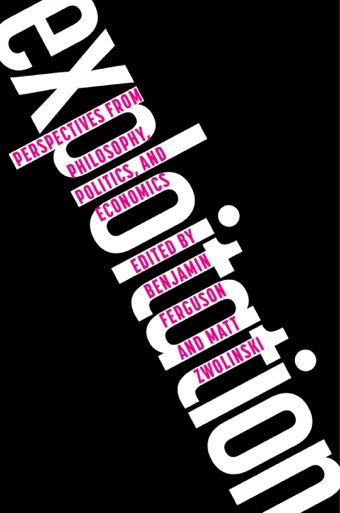
Exploitation: Perspectives from Philosophy, Politics, and Economics
Co-edited with Matt Zwolinski
This volume brings together leading scholars from philosophy, politics, and economics to explore exploitation as a moral and structural concept. It examines exploitation in labour, markets, and global justice, tracing its implications for fairness, coercion, and consent.
Oxford University Press, 2024.
@book{ferguson2024exploitation,
  editor = {Ferguson, Benjamin and Zwolinski, Matt},
  title = {Exploitation: Perspectives from Philosophy, Politics, and Economics},
  publisher = {Oxford University Press},
  address = {Oxford},
  year = {2024},
  isbn = {9780190256968}
}

The Routledge Companion to Libertarianism
Co-edited with Matt Zwolinski
This collection surveys the history, foundations, and frontiers of libertarian thought. It includes contributions from philosophers, political theorists, and economists examining topics such as rights, property, markets, and justice from libertarian perspectives.
Routledge, 2022.
@book{zwolinski2022companion,
  editor = {Zwolinski, Matt and Ferguson, Benjamin},
  title = {The Routledge Companion to Libertarianism},
  publisher = {Routledge},
  address = {London},
  year = {2022},
  isbn = {9781032247557}
}